TypeScript 7.0: Inside the 10x Faster Native Go Compiler
TypeScript 7.0's Go-based compiler delivers up to 12x faster builds. A deep dive into parallel type-checking, stableTypeOrdering, breaking changes, and how to migrate large codebases.
TypeScript 7.0: Inside the 10x Faster Native Go Compiler
If you've ever sat there watching tsc grind through a few million lines of code, you already know the tax large TypeScript projects pay: compilation latency. It creeps into everything — the CI job that used to take a minute now takes ten, the editor that used to autocomplete instantly now hangs for a second, the "just let me check one type error" that turns into a coffee break.
For over a decade, that was simply the cost of doing business. The TypeScript compiler (tsc) was self-hosted — TypeScript written in TypeScript, running on the single-threaded Node.js runtime. That design was great for bootstrapping the language and inviting community contributions, but it ran headfirst into a hard physical limit: one thread, one core, no matter how many cores your machine actually had sitting idle.
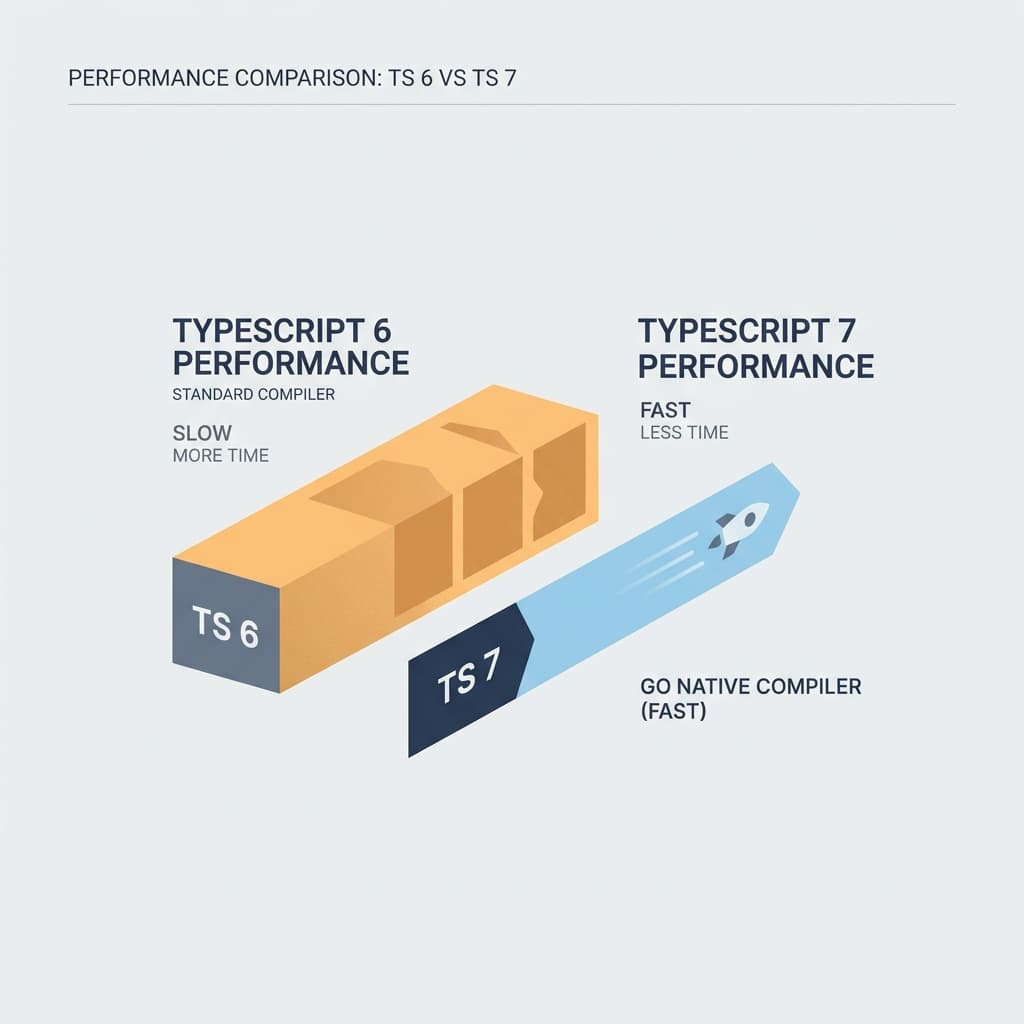
TypeScript 7.0 changes that equation. The team ported the compiler to Go and, for the first time, gave it real multi-core parallelism. According to Microsoft's own benchmarks, that shows up as builds that are typically 8x to 12x faster — and on some large codebases, considerably more.
This article walks through what actually changed under the hood, the new flags you'll want to know about, which defaults quietly shifted under you, and a practical path for migrating a large codebase without getting surprised.
Why Port the Compiler to Go?
To understand why this rewrite happened, it helps to look at what was actually slowing the old compiler down.
The single-threaded bottleneck
The legacy compiler runs through a sequential pipeline for every project:
- Parsing — converting source text into Abstract Syntax Trees (ASTs)
- Binding — linking identifiers to their declarations via symbol tables
- Type checking — verifying the relationships between types
- Emitting — writing out compiled JavaScript and
.d.tsdeclaration files
Because Node.js runs your code on a single main thread, CPU-bound work like type-checking can't take advantage of a 16-core workstation any more than it could a 4-core one. Even when you route your bundling through esbuild or Vite, the actual type-checking step — often forked out separately via something like fork-ts-checker-webpack-plugin — stays stuck on one core.
Rendering diagram...
Rendering diagram...
Why Go, specifically
The TypeScript team publicly weighed Rust and even Microsoft's own C# before landing on Go. Lead architect Anders Hejlsberg has explained the reasoning simply: Go was the lowest-level language available that still offered full native-code support across every target platform, plus strong built-in concurrency primitives. Team lead Ryan Cavanaugh has added a more practical reason on top of that: Go's syntax is close enough to JavaScript's that engineers can move between the two codebases without much friction, and Go's memory model lets the compiler sidestep garbage-collection overhead for most compilation runs.
That last point matters for a friend-to-friend explanation: Go still has a garbage collector, but its low-latency design means the compiler avoids the kind of unpredictable GC pauses that can freeze a large Node.js process mid-build.
Here's the detail that should give you confidence rather than dread: this was a port, not a rewrite from scratch. The team moved the existing compiler's structure and algorithms into Go file-by-file rather than redesigning the type system. That's what let Microsoft validate the new compiler against a decade of accumulated test cases — and against real production usage at companies including Bloomberg, Figma, Slack, Google, Vercel, and Notion during the pre-release period.
What Changed Architecturally
The Go-native compiler isn't a mechanical translation of the old codebase — it's a re-engineering of the parser, binder, and checker to take advantage of shared-memory concurrency.
At a conceptual level, here's the shape of it: a pool of worker goroutines reads and parses files in parallel, each building its own local AST and local symbol table. Those local tables are then merged into a shared global symbol table, which is the piece that most needs careful synchronization since multiple workers reference it simultaneously. Type-checking work — evaluating whether type A is assignable to type B, resolving generic relationships, and so on — is heavily cache-dependent, and the concurrent checker relies on thread-safe caches so that workers can share previously-computed relations instead of redoing that work.
The editor experience benefits from the same shift. The TypeScript 7.0 language server runs on the Language Server Protocol (LSP), and multiple goroutines can now handle editor requests — autocompletion, hover hints, diagnostics — at the same time. Practically, that means editing one file in a large monorepo doesn't freeze diagnostics for the rest of your project while the checker catches up.
The Benchmarks
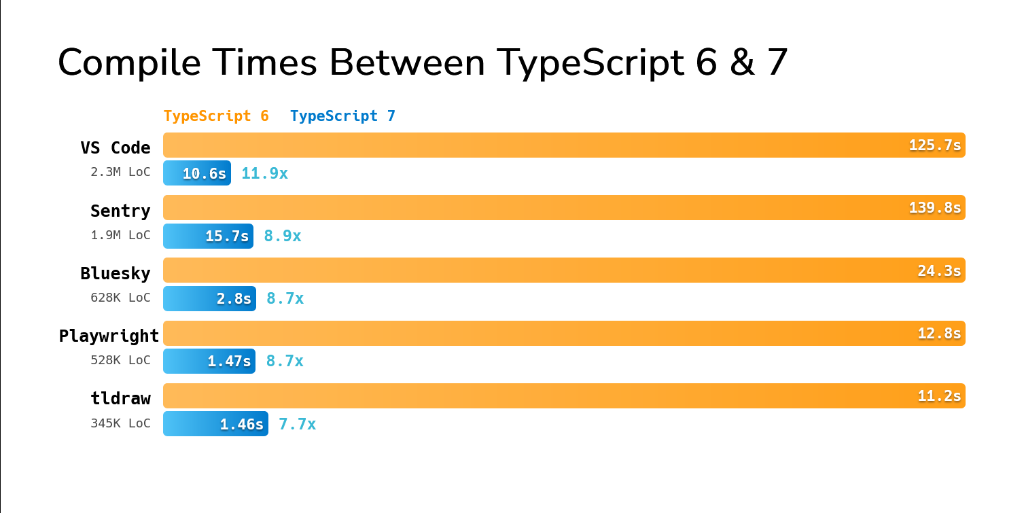
Numbers are more convincing than architecture diagrams, so here's what Microsoft's published benchmarks actually show for full builds, TypeScript 6.0 vs. 7.0:
| Project | Lines of Code | TypeScript 6.0 | TypeScript 7.0 | Speedup |
|---|---|---|---|---|
| VS Code | 2.3M | 125.7s | 10.6s | 11.9x |
| Sentry | 1.9M | 139.8s | 15.7s | 8.9x |
| Bluesky | 628K | 24.3s | 2.8s | 8.7x |
| Playwright | 528K | 12.8s | 1.47s | 8.7x |
| tldraw | 345K | 11.2s | 1.46s | 7.7x |
(Source: Microsoft's TypeScript 7.0 announcement and coverage from The Register.)
Editor responsiveness improved by a similar margin. Opening a file containing a type error inside the VS Code codebase dropped from roughly 17.5 seconds to under 1.3 seconds — a change developers actually feel, moment to moment, more than a CI dashboard ever will.
Memory usage improved too, though more modestly than the compile-time numbers: reported reductions run from about 6% to 26% across tested codebases, not the dramatic 2x-plus you might assume from the speed gains alone. It's a real win, just a smaller one than compile time — worth knowing so you don't oversell it to your team.
One more data point worth sharing: at Slack, engineers had reportedly stopped running full type-checks on their own machines entirely, routing that work to CI instead because it was too slow to sit through locally. With TypeScript 7.0's speed, that check became viable to run locally again — a small workflow change that adds up over a team's day.
Tuning Performance: --checkers and --builders
TypeScript 7.0 ships two flags that let you tune parallelism for your specific hardware — worth understanding before you just crank them to the max.
--checkers
This controls how many parallel type-checking worker goroutines the compiler spins up. It defaults to 4.
# Run type checking using 8 parallel checkers
tsc --checkers 8 --noEmit
On a beefy local workstation, raising this can meaningfully cut check time — Microsoft's own benchmarking found that bumping --checkers to 8 pushed the VS Code build from an 11.9x speedup to roughly 16.7x. But in a shared or containerized CI environment, be careful: if your runner reports 16 host cores but is actually only allocated 2 physical ones, auto-scaling up workers can cause thrashing or out-of-memory failures rather than a speedup. Set it explicitly for CI rather than trusting auto-detection.
--builders
This controls concurrency for building project references (composite: true in tsconfig.json) — relevant if you're working in a monorepo with multiple interdependent packages.
# Build project references using up to 8 concurrent builders
tsc --build --builders 8
If project C depends on B, which depends on A, that chain still has to build sequentially. But independent projects — say D and E, which don't depend on each other — can build in parallel.
Rendering diagram...
One thing to watch: --checkers and --builders multiply. Running --checkers 4 --builders 4 can spin up to 16 concurrent checker instances. That's fine on a 32-core CI box and a recipe for contention on a laptop — tune both together, not independently.
Stable Type Ordering: Why It Exists
This is the part of the release that's easy to skim past but genuinely matters if you rely on generated .d.ts files for anything — API diffing, publishing packages, or comparing build output across environments.
The non-deterministic ID problem
In the old single-threaded compiler, types got sequential internal IDs in the order they were encountered during parsing. Since parsing was strictly sequential, those IDs — and therefore the order types appear in union types, intersections, and emitted declaration files — were stable and reproducible across runs.
Parallelize the parser, though, and file-processing order stops being predictable; it now depends on thread scheduling, disk I/O timing, and core availability. Run the same build twice and you could, in principle, get a differently-ordered A | B vs. B | A in your output — not a type-checking bug, but noisy enough to break diffing tools and confuse anyone comparing build artifacts across machines.
Run 1 parsing order: fileA.ts → fileB.ts  ⇒ emits: A | B
Run 2 parsing order: fileB.ts → fileA.ts  ⇒ emits: B | A
The fix: content-based, deterministic sorting
TypeScript's solution is to stop ordering types by when they were encountered and instead sort them by a deterministic algorithm based on the type's own content. Every checker worker ends up agreeing on the same order regardless of which one processed a given type first.
This shipped first as an opt-in flag, stableTypeOrdering, in TypeScript 6.0 — specifically so teams could preview 7.0's ordering behavior and diff their output before migrating. It's worth knowing that turning it on in 6.0 comes with a real cost: Microsoft's own docs note it can slow down type-checking by up to 25%, so treat it as a migration diagnostic, not something to leave on permanently pre-upgrade.
In TypeScript 7.0, it's simply always on:
// tsconfig.json
{
  "compilerOptions": {
    "target": "es2022",
    "module": "esnext",
    "strict": true
    // stableTypeOrdering no longer needs to be set — it's the only behavior in 7.0.
  }
}
Defaults That Quietly Changed
TypeScript 7.0 doesn't introduce a fresh batch of breaking changes so much as it turns TypeScript 6.0's deprecation warnings into hard errors. The reassuring part: if your project already compiles cleanly on 6.0 with stableTypeOrdering enabled and no ignoreDeprecations flag set, it should compile identically on 7.0.
Here's what shifted:
| Option | New default |
|---|---|
strict | true |
module | esnext |
target | current stable ECMAScript version |
noUncheckedSideEffectImports | true |
stableTypeOrdering | true (can't be turned off) |
rootDir | ./ |
types | [] (no more auto-discovering every @types/* package) |
libReplacement | false |
noUncheckedSideEffectImports is the one that quietly catches the most people. It checks that a side-effect-only import actually resolves to a real file:
// Now a hard error in TypeScript 7.0 if the file doesn't exist:
import "./styles-typo.css";
// Error: Cannot find module './styles-typo.css' or its corresponding type declarations.
If you've ever had a typo'd CSS import silently do nothing, this is the fix — a class of bug that used to fail silently now fails loudly, at compile time, where you actually want it to.
What's gone entirely
A handful of legacy options were removed rather than just deprecated:
target: "es5"— no longer supported natively. If you need to support pre-ES2015 runtimes, compile withtscto a modern target first, then transpile down with Babel, swc, or esbuild.- Legacy module formats — AMD, UMD, and SystemJS emit support is gone. The compiler focuses on ESM and CommonJS.
node/node10/classicmodule resolution — replaced bynodenextandbundler. If yourtsconfig.jsonstill references the old modes, switch to one of these:
{
  "compilerOptions": {
    "moduleResolution": "bundler"
  }
}
baseUrl— removed; use relativepathsmappings instead.
One more genuinely semantic change worth flagging if you do any type-level string manipulation: template literal types now treat Unicode code points (like emoji) as single units, rather than splitting them into UTF-16 surrogate pairs the way JavaScript's raw indexing does. If you had a Length<T> utility type relying on the old surrogate-pair behavior, double-check it against 7.0.
The Ecosystem Gap: No Stable API (Yet)
Here's the honest caveat, the one your friend-who-actually-tried-it would tell you before you upgrade a big project: TypeScript 7.0 does not ship a stable programmatic JavaScript API. That's expected in 7.1.
Historically, plenty of tools reached into the compiler directly from Node.js:
// This pattern breaks under TypeScript 7.0 —
// there's no in-process JS compiler to import anymore.
const ts = require('typescript');
const program = ts.createProgram(fileNames, options);
Because the 7.0 compiler is a native Go binary, that in-process hook simply isn't there yet. Tools affected include:
- Vue, Svelte, and Astro tooling (via Volar)
- Angular's template type-checking
ts-jest,ts-loader,ts-node- Custom transformers and code-generation pipelines built on the TypeScript API
To bridge the gap, Microsoft has published a compatibility package, @typescript/typescript6, which contains the legacy JavaScript-based engine for tools that still need programmatic access:
{
  "devDependencies": {
    "typescript": "^7.0.0",
    "@typescript/typescript6": "^6.0.0",
    "typescript-eslint": "^8.0.0"
  }
}
In practice, that means your tsc CLI runs the fast native compiler for builds and checks, while ESLint or a framework's template parser keeps using the legacy engine in-process until 7.1 lands. If your stack is plain React or Node.js without embedded-language tooling, you likely won't hit this wall at all and can upgrade right away.
A Practical Migration Path
If you're migrating a real codebase rather than a toy project, here's a sequence that tends to go smoothly:
Rendering diagram...
1. Get clean on TypeScript 6.0 first, with stableTypeOrdering enabled and no ignoreDeprecations flags set. This single step is the best predictor of a smooth 7.0 upgrade — it surfaces almost every breaking change while you're still on a JavaScript-based compiler you can debug normally.
2. Set types explicitly. The empty-array default is one of the most common breakage points:
{
  "compilerOptions": {
    "types": ["node", "jest"]
  }
}
3. Check rootDir. If your build output starts including path segments you didn't expect (e.g. dist/src/index.js instead of dist/index.js), this is usually why.
4. Update module and target settings. Swap es5 targets and legacy module resolution modes for their modern equivalents before you touch 7.0 at all.
5. Install and run side-by-side.
npm install --save-dev typescript@7.0.0 @typescript/typescript6
6. Wire up your scripts with explicit worker counts rather than trusting auto-detection, especially in CI:
{
  "scripts": {
    "type-check": "tsc --noEmit --checkers 4",
    "build": "tsc --build --builders 4"
  }
}
7. If you depend on Vue, Svelte, Astro, or Angular template type-checking, keep those tools pointed at @typescript/typescript6 until 7.1 ships a stable API — don't fight this one, just wait it out.
Frequently Asked Questions
Is TypeScript 7.0 backward compatible with TypeScript 6.0 code?
Yes — the type system itself didn't change. Code that compiles cleanly under TypeScript 6.0 with strict options and stableTypeOrdering enabled should compile identically under 7.0. The breaking changes live in configuration defaults and the programmatic API, not in type-checking semantics.
How much does memory usage actually improve? More modestly than the speed numbers suggest — Microsoft's reported figures put it at roughly 6% to 26% across tested codebases, not a dramatic multiple. Worth knowing so you can set realistic expectations with your team.
Can I use Vue, Svelte, or Astro with TypeScript 7.0 today?
You can, but their tooling needs to be pointed at the @typescript/typescript6 compatibility package for template type-checking, since it depends on the programmatic API that isn't stable in 7.0 yet. You can still run tsc --noEmit with the fast native compiler for your own code in parallel.
Where This Goes Next
The last few years produced a wave of Rust- and Go-based JavaScript tooling — fast bundlers, fast linters — often framed as leaving a "slow" TypeScript compiler behind. TypeScript 7.0 quietly undercuts that narrative. Full type inference was always the one piece those tools couldn't replace, and now the piece that made TypeScript feel heavy is native and parallel too.
The more interesting shift probably isn't this quarter's CI bill — it's what becomes possible once a full-project type-check takes single-digit seconds instead of minutes. Running it on every save, inside a pre-commit hook, or in the inner loop of an AI coding agent stops being impractical. That's less a performance patch and more a change in what kind of tooling gets built on top of TypeScript next.
Further reading:
Related
Resources
How MCP Works: A Complete Guide to Model Context Protocol

Mastering AI-Assisted Coding: Practical Workflows for 2026

React Compiler: The End of useMemo and useCallback

Cognitive Load in Modern Software Architecture: A Visual Guide